

BY LEANDER C. DOMINGO
THE incident in Dupax del Norte highlights the tension between judicial enforcement and community resistance over mining exploration.
On Friday, January 23, 2026, the Nueva Vizcaya Police Provincial Office (NVPPO) announced that a human barricade along Sitio Keon barangay road was dispersed peacefully, resulting in the arrest of seven individuals, including anti-mining leader Florentino Daynos.
Police Colonel Paul Bometivo stressed that the role of the Philippine National Police (PNP) was limited to assisting the court in executing its writ, acting under the principle of maximum tolerance and without initiating enforcement on its own .
The operation stemmed from a Writ of Preliminary Injunction issued by Regional Trial Court Branch 30 in Bayombong, presided over by Judge Paul Attolba Jr. The writ ordered the removal of any obstruction—physical or human—along the access road leading to Woggle Corporation’s exploration site, which holds Exploration Permit No. 00030‑II from the Department of Environmet and Natural Resources – Mines and Geosciences Bureau (DENR‑MGB).
Earlier, protesters let the dismantling of a steel gate but then formed a human barricade, which the court deemed “patent disobedience” and a circumvention of judicial authority. The January 19 order explicitly authorized sheriffs, with police assistance, to arrest anyone who “refuses, resists, or obstructs” the writ without need for further court direction, and to identify participants for possible indirect contempt of court, punishable by fines and imprisonment.
From a legal perspective, the court’s stance reflects a strict interpretation of judicial supremacy: a writ is a command, not a suggestion, and any act intended to thwart it can be treated as contempt.
The PNP’s justification that it merely “assisted” the judiciary underscores the separation of powers—police act as agents of the court, not as independent enforcers of mining policy. This framing aims to shield law‑enforcement from accusations of any or political bias, while placing responsibility for compliance squarely on the protesters.
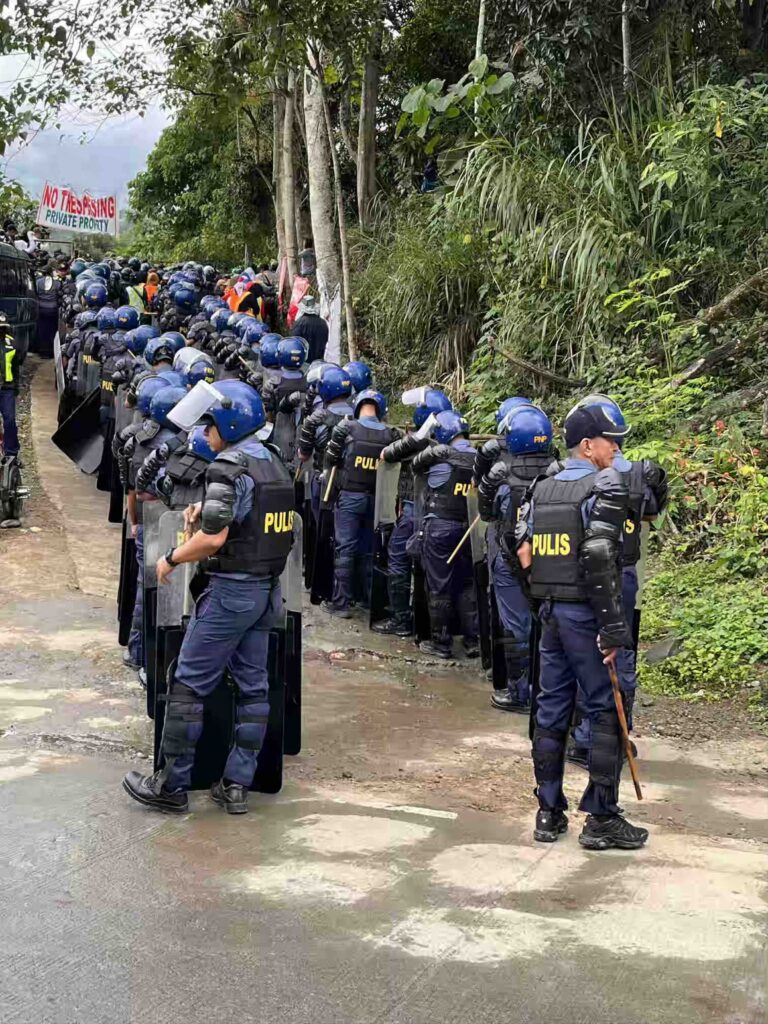
Conversely, community and advocacy groups view the same actions as criminalization of legitimate dissent. Reports from Katribu, ATM, and other NGOs describe the barricade as a “collective act of self‑defense” against displacement and environmental harm, and they condemn the arrests as state‑backed repression of indigenous peoples and local residents defending their land and livelihoods.
They argue that the court’s order effectively weaponizes the law to protect corporate interests, sidelining constitutional rights to peaceful assembly and free expression.
The broader context involves Republic Act No. 7942 (Philippine Mining Act of 1995), which vests regulation of mining activities in government agencies and the judiciary. Disputes over exploration permits, environmental impact, and ancestral domain (the latter of which is not the case in the Dupax del Norte case) are meant to be resolved through administrative and judicial channels, not through self‑help measures like barricades.
Yet, critics point out that some of these processes are often inadequate, creating a legitimacy gap that fuels on‑the‑ground resistance.
In sum, the Dupax del Norte case illustrates a classic clash: court‑ordered enforcement of a mining permit versus grassroots opposition rooted in environmental and indigenous rights concerns, (and to some observers, it is purely politically motivated).
The police maintain they acted professionally and with restraint, while activists claim the operation exemplifies state‑facilitated corporate plunder. The outcome will likely hinge on how the contempt proceedings unfold and whether bona fide members of communities who are affected pursue legal remedies or continue non‑violent protest.