

BY LEANDER C. DOMINGO
THE recent court ruling in Nueva Vizcaya, directing the removal of barricades blocking Woggle Corporation’s exploration site, is a significant victory for the rule of law. This decision underscores that dissent is protected, but obstruction is not.
Presided by Judge Paul Attolba Jr., the Regional Trial Court, Branch 30 of Bambang’s Consolidated Resolution on January 6, 2026, upheld a writ of preliminary injunction sought by Woggle Corporation, emphasizing that judicial orders are binding and must be respected.
The court upheld a writ of preliminary injunction sought by Woggle Corporation against Florentino Daynos and others, ordering the immediate removal of barricades that had blocked public access to a mining exploration area.
The court’s decision is not a victory for mining over protest, but rather a reaffirmation of the importance of process and the limits of lawful protest. Woggle Corporation has obtained the necessary permits and approvals from the government, including a Certificate of Non-Overlap from the National Commission on Indigenous Peoples or NCIP, confirming that no recognized indigenous cultural communities or ancestral domains exist within the exploration area.
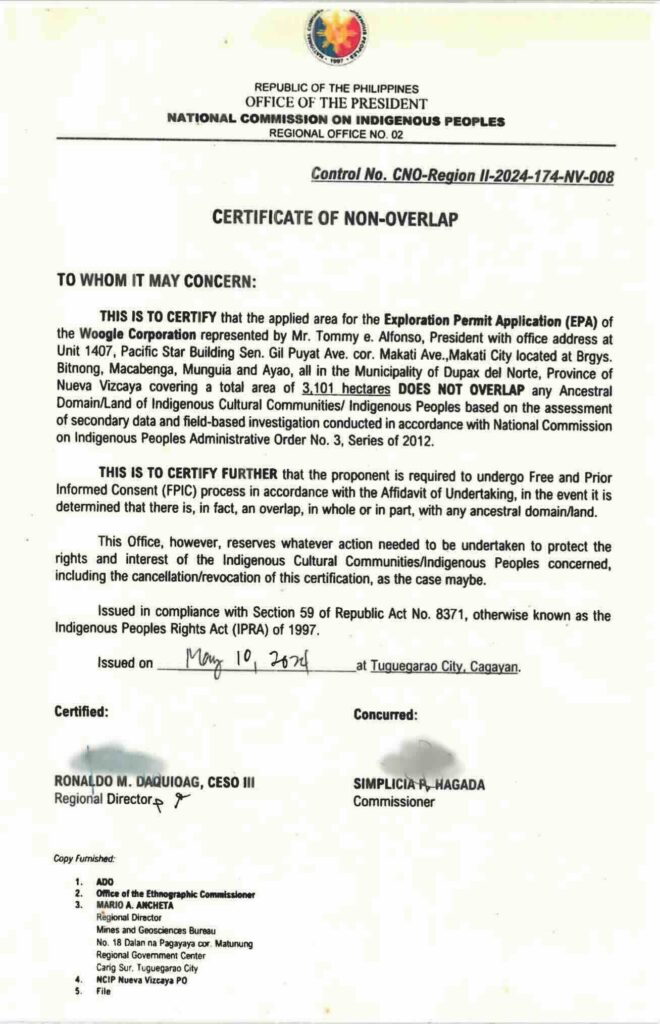
Reports said that the company has also made every effort to conduct community consultations with several barangays and local councils before resuming exploration. This demonstrates their commitment to responsible mining practices and respect for affected communities.
The court’s ruling serves as a cautionary tale for all sides. Advocacy that crosses into obstruction weakens its own moral claim, while corporate activity that proceeds without social license courts resistance. Institutions that hesitate to enforce lawful orders invite anarchy.
In the end, this is not a story about mining versus the environment, but about whether disputes in a democracy are settled by barricades or by courts. The Nueva Vizcaya ruling makes clear which path the Constitution prefers.